Lab use only. OracleSecLab is an app I wrote with these bugs on purpose, to teach database security. Everything below runs against my own copy on
localhostin Docker. Never point these techniques at a system you do not own or have permission to test.
OracleSecLab is a university portal (“FPT Student Portal”) on Oracle 23c Free,
PHP 8.3 and Apache. I built it to practise against Oracle, which behaves unlike
the MySQL and PostgreSQL labs most people learn on: its own SQL dialect (DUAL,
ROWNUM, USER_TABLES), its own PL/SQL, its own injection and enumeration
habits. I go at it black-box, with nothing but the running app, and find four bugs
hidden among dozens of ordinary pages.
| # | Vulnerability | Where | OWASP 2021 |
|---|---|---|---|
| 1 | Oracle UNION SQL injection (fragmented flag) | search.php?q= |
A03 Injection |
| 2 | Business-logic flaw (negative quantity) | store.php |
A04 Insecure Design |
| 3 | Broken access control into supply-chain poisoning | partner_config.php + admin.php |
A01 / A06 |
| 4 | Oracle PL/SQL injection (EXECUTE IMMEDIATE) |
course_lookup.php |
A03 Injection |
Scope and rules of engagement
The scope is one target: the dbs401-oracle-app on http://localhost:8080 and the
Oracle database behind it. Everything the app serves is fair game. Nothing outside the
container is.
It is a black-box test. I get no source code and no database credentials, only the two
ordinary app logins any user would have (student1, and later admin). I work from
the running app alone and infer the rest from how it behaves.
Rules of engagement are simple because I own the box and nobody else is on it: it runs on my own machine, not a shared or production system, so any technique is allowed, injection and fuzzing included, and I need no change window or emergency contact. Nothing here is destructive: I read and extract, I do not drop tables or wipe data.
Run it yourself
The whole lab is one command, no Oracle install:
git clone https://github.com/Khanh1916/oracle-sec-lab.git
cd oracle-sec-lab
RANDOMIZE_FLAGS=1 docker compose up -d
Then open http://localhost:8080/dbs401-oracle-app and log in. The accounts I use
below:
| Username | Password | Role |
|---|---|---|
student1 |
Student@123 |
Student (150 credits) |
admin |
Admin@DBS401!2024 |
Admin |
A note on the flags. Every flag here has the shape
DBS401{...}. I ran my copy withRANDOMIZE_FLAGS=1, so every flag in the screenshots is a throwaway value for that one container, not the real answer. The point is for you to produce the flag yourself instead of copying the final string.
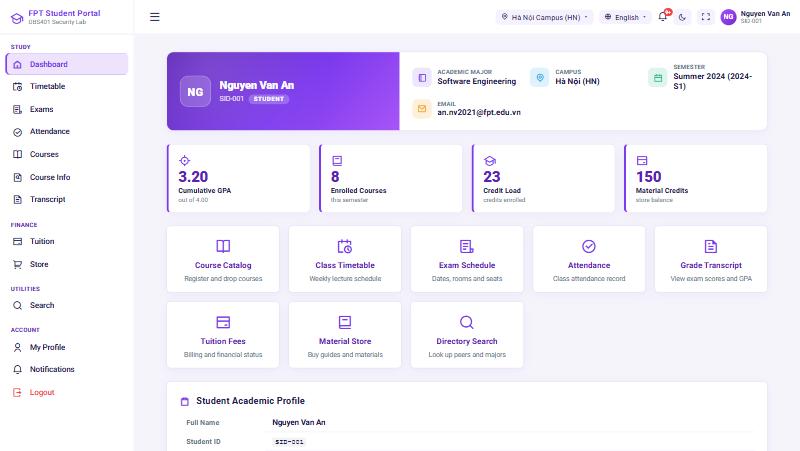
Here is the portal after I log in as student1, an ordinary academic dashboard.
None of it matters to the bugs.
Recon
First, what is the server running. I look at the headers and the URL endings:
curl -sI http://localhost:8080/dbs401-oracle-app/ | grep -iE 'server|x-powered-by'
Apache and PHP, and every page ends in .php. The backend is not obvious yet, but
the lab name (DBS401) and the SQL errors later make it Oracle.
Next I map the app: walk the whole left menu for the public pages, then fuzz paths and parameters for the hidden parts:
ffuf -u 'http://localhost:8080/dbs401-oracle-app/FUZZ.php' -w words.txt -mc 200,302
ffuf -u 'http://localhost:8080/dbs401-oracle-app/admin.php?FUZZ=1' -w params.txt -mc 200
That gives the interesting surface: search.php (Student Search), store.php
(Material Store) and course_lookup.php (Course Info) are in the menu;
partner_config.php and a check_updates parameter on admin.php only show up
through fuzzing.
Now, which pages are likely to break. The ones that only display static data, timetables, transcripts, I skip. The suspicious ones take my input and push it to the server: Student Search (free text that probably ends up in a query), Material Store (a quantity field, an easy money-math bug), Course Info (a lookup by code that hits the database), and the admin update (it pulls a file from outside, a supply-chain risk). A quick single-quote-and-odd-number probe confirms them.
Assets
Before exploiting anything, I take stock of what is actually worth reaching in this app, and how sensitive each piece is. That is what decides which findings matter later.
| Asset | Where | Sensitivity | Why it matters |
|---|---|---|---|
| Student records (PII) | STUDENTS and related tables |
High | Names, IDs and academic data, a privacy breach on its own |
| The four flags | FLAGS, AUDIT_LOGS, CONFIG_STORE, PLSQL_VAULT |
High | The goal of the lab, standing in for any crown-jewel secret |
| Database config and secrets | CONFIG_STORE (e.g. update_url) |
High | Internal URLs and settings that open further attacks |
| Admin functions | admin.php, partner_config.php |
High | Privileged actions a normal user should never reach |
| Partner update integration | the check_updates flow |
Critical | Pulls and runs an external file, a foothold for code execution |
| Audit logs | AUDIT_LOGS |
Medium | Useful to an attacker for hiding, and it also leaks a flag fragment |
Challenge 1: Oracle UNION SQL injection
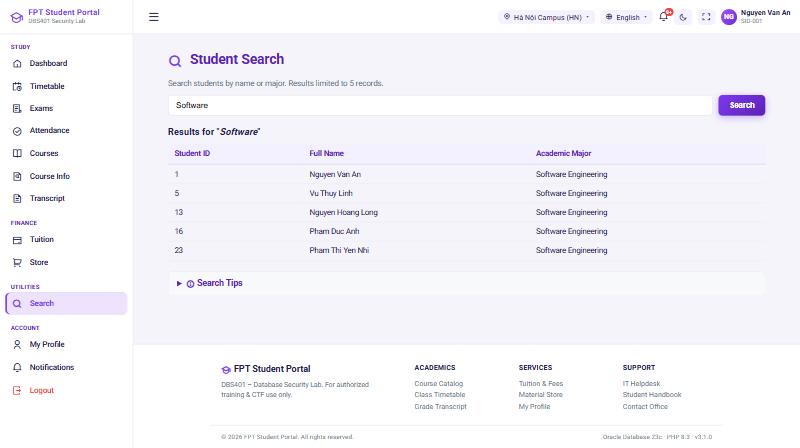
The Student Search page (search.php) looks ordinary. Search a real major and you
get a table of students:
The first probe is a single quote. Send ?q=' and the page returns “Search
failed” instead of results, a caught error rather than a stack trace:
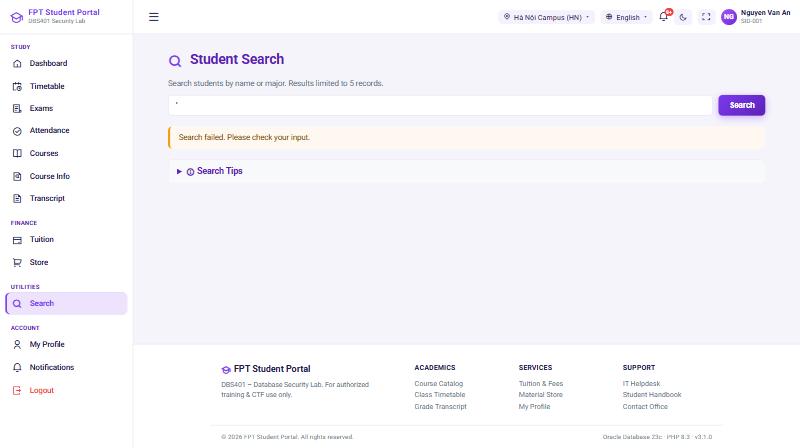
That error on a lone quote is the tell: the input reaches the query and breaks its
syntax, but the app hides the details (blind SQLi). From the way the search
behaves, the input goes into a LIKE '%...%' match inside parentheses, so to take
over the query I close the quote and the parenthesis and comment out the rest. The
prefix is KEYWORD%') ... --.
Testing a few keywords shows a filter: DDL words like DROP and UPDATE come back
rejected, but UNION SELECT goes through. The filter is a plain substring match,
so even update_url is rejected because it contains UPDATE. That matters in
Challenge 3.
Oracle UNION needs the same column count and compatible types on both sides, and
every SELECT needs a FROM (that is what DUAL is for). A 1,2,3 guess fails
on type, so I feed strings:
x%') UNION SELECT 1,'a','b' FROM DUAL--
USER_TABLES lists the schema’s tables:
x%') UNION SELECT ROWNUM, table_name, NULL FROM USER_TABLES WHERE ROWNUM<=14--
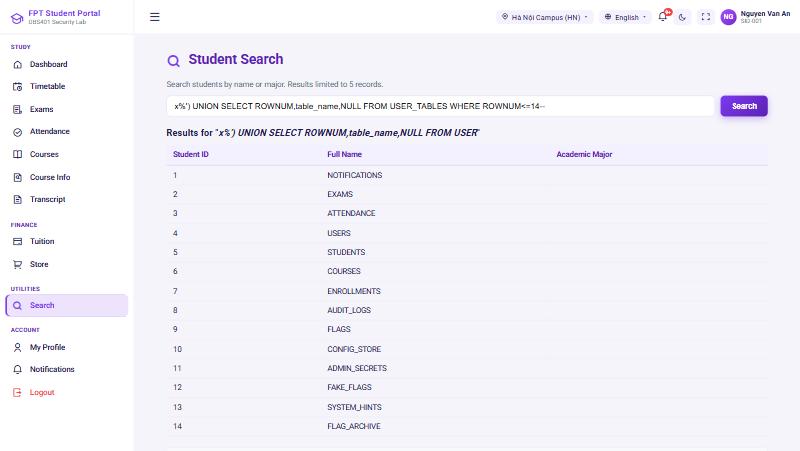
Some names stand out: FLAGS, AUDIT_LOGS, CONFIG_STORE, plus decoys like
FAKE_FLAGS and FLAG_ARCHIVE. Dumping FLAGS gives a fragment and a decoy:
x%') UNION SELECT 1, flag_code, flag_part FROM FLAGS--
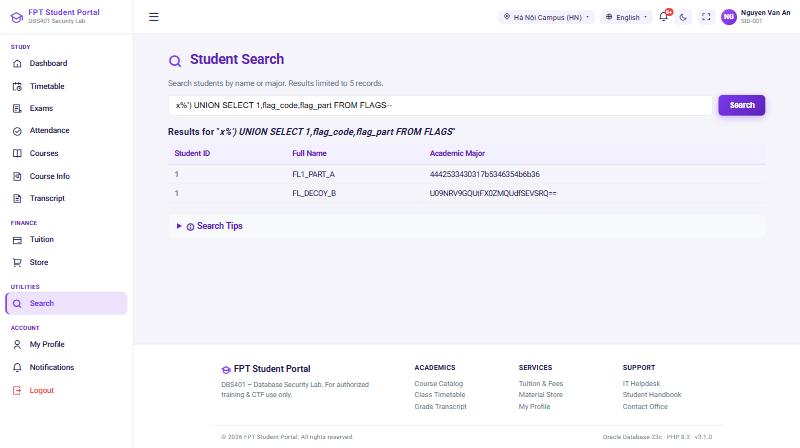
FL1_PART_A is hex (decode it and it starts DBS401{SQL_). FL_DECOY_B is base64
for SOME_FAKE_FLAG_HERE, so ignore it. The other two real pieces sit elsewhere,
in different encodings:
- Part B in
AUDIT_LOGS.metadata_note, a JSON fragment written backwards. - Part C in
CONFIG_STOREundersys_alpha_marker, base64.
x%') UNION SELECT 1, metadata_note, action FROM AUDIT_LOGS
     WHERE action='SYSTEM_AUDIT_CHECK'--

x%') UNION SELECT 1, config_value, config_key FROM CONFIG_STORE
     WHERE config_key='sys_alpha_marker'--
Decode each piece (hex to ASCII, reverse the string, base64 to ASCII) and join
them into one DBS401{SQL_..._..._...} flag. Two base64 decoys in CONFIG_STORE
and FLAGS are there to waste a scanner’s time; a clean decode is not the same as
a correct one.
Challenge 2: a negative quantity is free money
The Material Store (store.php) sells a cheap study guide (100 credits) and one
locked item, “Exam Leak 2024 (CLASSIFIED)”, for 999,999 credits. My account has
150:
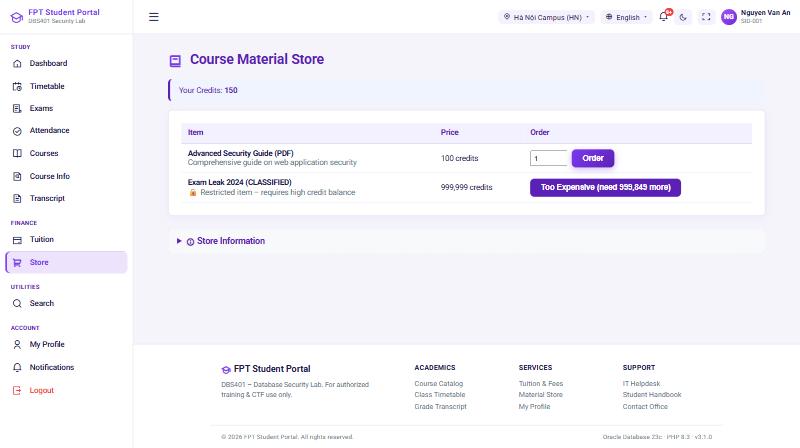
The order form checks that I can afford it, but not that the quantity is positive. Ordering a negative quantity makes my balance go up instead of down, so the server is doing cost = qty × price and subtracting that from my credits. Order −10,000 of the 100-credit guide:
cost        = -10,000 * 100          = -1,000,000
new_credits =    150 - (-1,000,000)  =  1,000,150
Subtracting a negative adds it. The balance jumps past 999,999 and the locked item unlocks, with the flag:
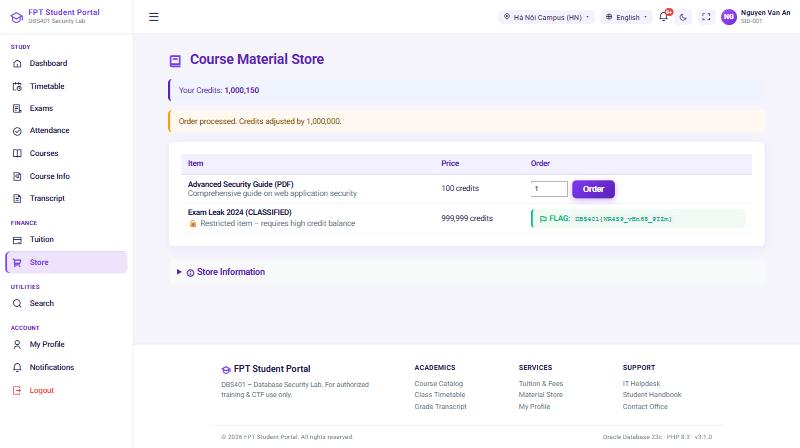
No injection, no tooling, just an input the form never expected.
Challenge 3: broken access control into a supply-chain poison
The check_updates action I found during recon reads a partner manifest URL,
fetches that JSON, and if the manifest claims a newer version it processes the
payload. Control that URL and I control what the admin’s server fetches.
The URL is a private config row, not shown in the UI. I already have SQL injection
from Challenge 1, so I dump CONFIG_STORE. I cannot name update_url (the filter
blocks UPDATE), so I dump the whole table and read the row:
x%') UNION SELECT 1, config_key, config_value FROM CONFIG_STORE
     WHERE config_key NOT LIKE 'runtime%'--
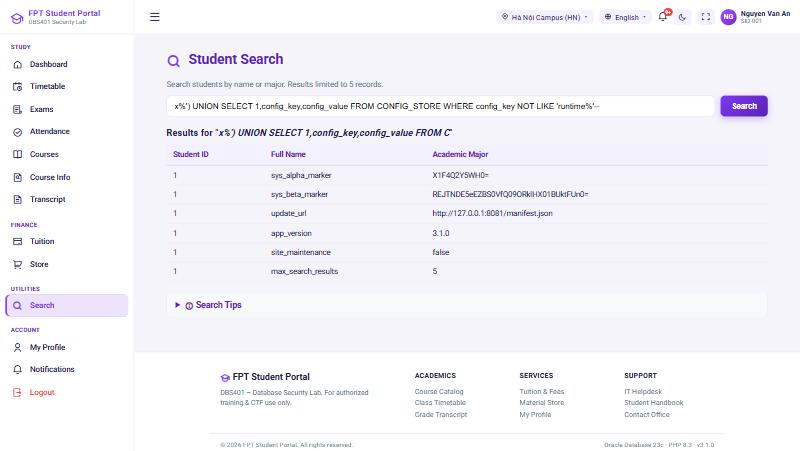
The server fetches updates from http://127.0.0.1:8081/manifest.json, and the
current app_version is 3.1.0. To trigger the update path my manifest has to
claim a higher version.
A hidden page, partner_config.php, changes that URL. It is labelled “ADMIN ONLY”,
but it only checks that I am logged in, nothing more, so an ordinary student
account can open it and change partner config:
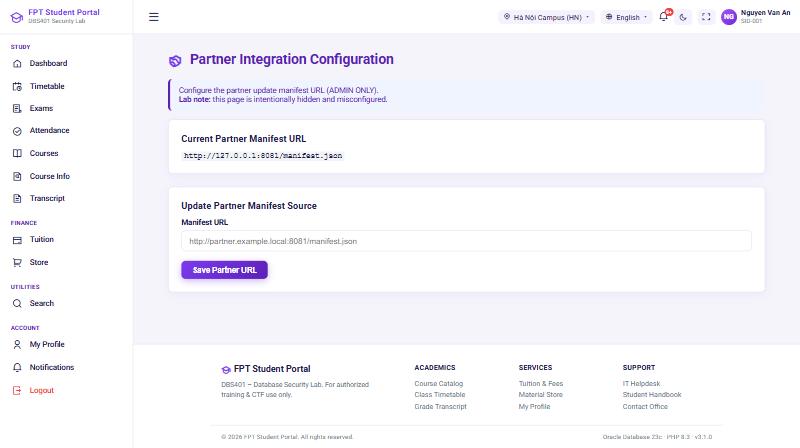
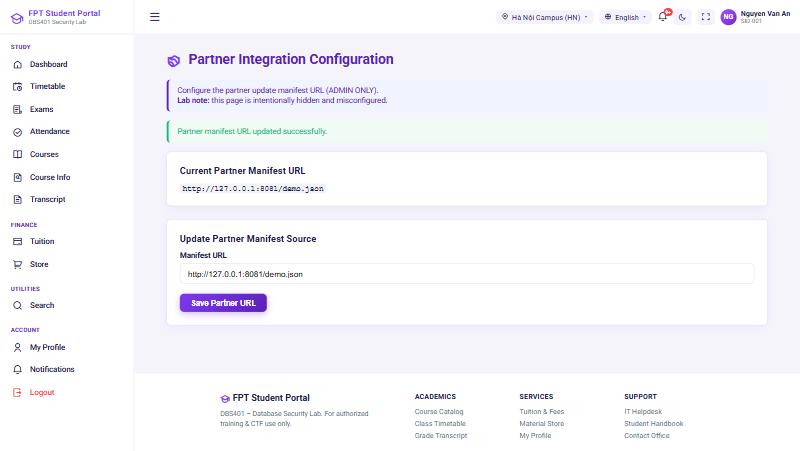
I point the URL at a manifest of my own (in the lab, demo.json, version 9.9.9
with the expected flag_part). The save goes through:
Back as admin, “check for updates” fetches my manifest, sees 9.9.9 > 3.1.0,
trusts it, takes the flag_part from my file, combines it with a server-side half,
and hex-decodes the result onto the page:
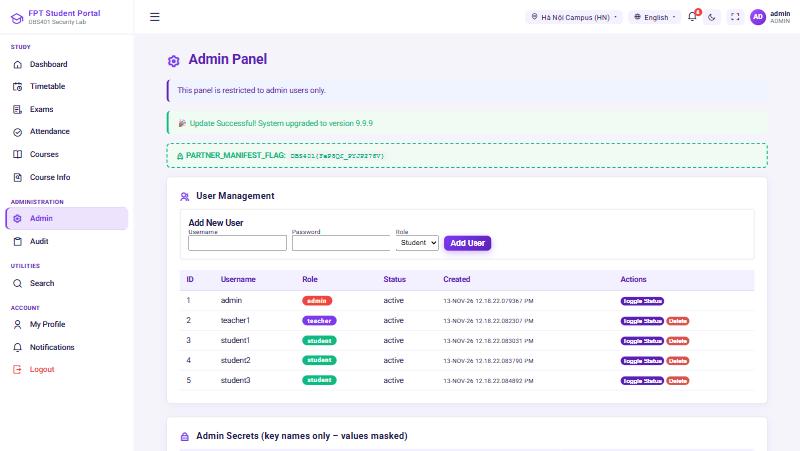
“Update successful! System upgraded to version 9.9.9”, and the flag drops out. A student with no privileges got data of their choosing run inside the admin’s trust. That is a supply-chain attack: you compromise something the target trusts and let the target pull it in.
Challenge 4: PL/SQL injection through EXECUTE IMMEDIATE
The Course Info lookup (course_lookup.php) takes a course code. A normal code
returns a normal course name:
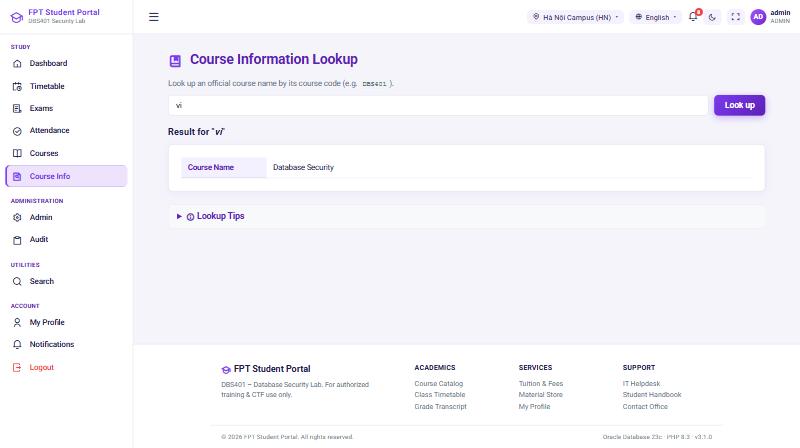
The code looks like it is passed as a bound parameter, which should be safe. But
injecting into it still returns data, so the value must end up in dynamic SQL
deeper in: a stored function that concatenates the code into a string and runs it
with EXECUTE IMMEDIATE. The bind at the call site protects nothing once that
happens.
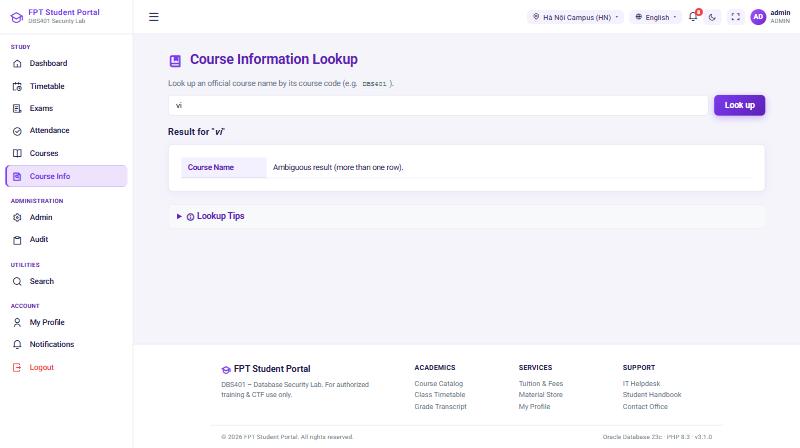
The lookup returns a single value, so the injected query has to return exactly one
row. The obvious payload hits two rows, and the function reports “Ambiguous result”
(Oracle’s TOO_MANY_ROWS):
zzz' UNION SELECT secret_flag FROM PLSQL_VAULT--
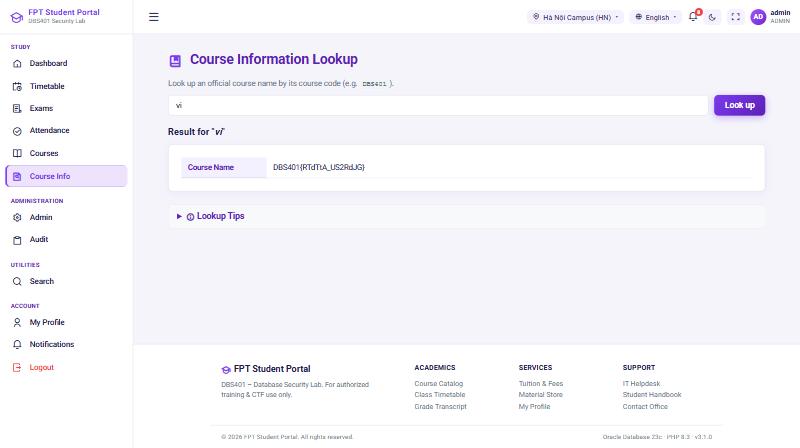
Filter to the one real row and the flag comes back as a course name:
zzz' UNION SELECT secret_flag FROM PLSQL_VAULT WHERE label='CHALLENGE_4'--
Impact
Each bug’s severity the way a pentest report scores it, likelihood times impact:
| Vulnerability | Likelihood | Impact | Severity |
|---|---|---|---|
| UNION SQL injection | High, a single quote gets in | Reads the whole database: student records, config, secrets | Critical |
| Negative-quantity logic | High, just a negative number | Mint credits and buy restricted items, scoped to the store | High |
| Broken access control + supply chain | Medium, chains SQLi with a hidden page | Makes the admin server fetch and run an attacker-controlled file | Critical |
| PL/SQL injection | High, injects through the lookup | Reads a protected vault that looked safe | High |
Remediation
Each bug has a direct fix, ordered here by how badly it bites.
| Vulnerability | Fix |
|---|---|
| UNION SQL injection | Use bind variables for every query and never build SQL by string concatenation. Validate input against an allow-list, and run the app on a least-privilege database account, not one that can read every table. The substring filter here is not a defence and should go. |
| Broken access control + supply chain | Check authorization on the server for every privileged action, by role, not just “logged in”. For updates, pin the source, verify the manifest with a signature or checksum, and never trust a version number the client controls. |
| PL/SQL injection | Keep EXECUTE IMMEDIATE on bind variables and never concatenate user input into the dynamic statement. Validate identifiers with DBMS_ASSERT. |
| Negative-quantity logic | Validate the quantity on the server (an integer greater than zero) and re-check every business rule, like the balance, server-side before the order commits. |
Source and full setup: github.com/Khanh1916/oracle-sec-lab
OracleSecLab là app tôi tự viết, cố ý cài sẵn các lỗ hổng để dạy về bảo mật cơ sở dữ liệu. Mọi thứ bên dưới chạy trên máy cá nhân, ở
localhost, trong Docker. Các lỗ hổng đều là cố ý. Không áp dụng các kỹ thuật này lên hệ thống bạn không sở hữu hoặc chưa được phép.
OracleSecLab là một fake academy portal (“FPT Student Portal”) chạy trên Oracle
23c Free, PHP 8.3 và Apache. Tôi dựng nó để luyện trên Oracle, vốn khác với các
lab MySQL, PostgreSQL mà đa số người học quen: cú pháp SQL riêng (DUAL, ROWNUM,
USER_TABLES), có PL/SQL, và lối inject, liệt kê bảng riêng. Ở đây tôi tiếp cận
bài toán theo hướng black-box, chỉ tương tác với ứng dụng đang chạy, từ đó phát
hiện bốn lỗ hổng nằm xen lẫn giữa các tính năng thông thường.
| # | Lỗ hổng | Ở đâu | OWASP 2021 |
|---|---|---|---|
| 1 | Oracle UNION SQL injection (flag chia mảnh) | search.php?q= |
A03 Injection |
| 2 | Lỗi business logic (số lượng âm) | store.php |
A04 Insecure Design |
| 3 | Broken access control thành supply-chain poisoning | partner_config.php + admin.php |
A01 / A06 |
| 4 | Oracle PL/SQL injection (EXECUTE IMMEDIATE) |
course_lookup.php |
A03 Injection |
Scope and rules of engagement
Phạm vi kiểm thử gói gọn trong một mục tiêu: dbs401-oracle-app tại http://localhost:8080
và cơ sở dữ liệu Oracle phía sau. Toàn bộ các endpoint và tính năng do ứng dụng cung cấp
đều thuộc phạm vi kiểm thử; mọi thành phần ngoài container đều nằm ngoài phạm vi.
Đây là đánh giá black-box: không có mã nguồn, không có thông tin đăng nhập database,
chỉ khởi đầu với tài khoản người dùng thông thường (student1, sau đó mở rộng sang
admin). Mọi phán đoán về cấu trúc bên dưới đều dựa trên phản hồi thực tế của ứng dụng.
Quy tắc phối hợp (Rules of engagement) được xác định rõ ràng: môi trường lab chạy cục bộ trên máy cá nhân, không ảnh hưởng đến hệ thống dùng chung hay môi trường production, do đó có thể tự do áp dụng các kỹ thuật tấn công từ injection đến fuzzing mà không cần đặt khung thời gian bảo trì. Quá trình kiểm thử không thực hiện các hành động phá hoại, chỉ trích xuất dữ liệu phục vụ mục đích học tập mà không xóa hay can thiệp vào cấu trúc bảng.
Môi trường thực hành
Cả lab gói trong một câu lệnh, không cần cài Oracle:
git clone https://github.com/Khanh1916/oracle-sec-lab.git
cd oracle-sec-lab
RANDOMIZE_FLAGS=1 docker compose up -d
Mở http://localhost:8080/dbs401-oracle-app rồi đăng nhập. Hai tài khoản tôi dùng
ở dưới:
| Tài khoản | Mật khẩu | Vai trò |
|---|---|---|
student1 |
Student@123 |
Student (150 credit) |
admin |
Admin@DBS401!2024 |
Admin |
Lưu ý về flag. Flag ở đây đều có dạng
DBS401{...}. Tôi bậtRANDOMIZE_FLAGS=1khi chạy, nên mỗi flag trong hình chỉ là giá trị random của riêng container đó, không phải đáp án thật. Mục đích là muốn bạn tự làm ra flag chứ không copy sẵn đáp án.
Đây là trang portal sau khi đăng nhập bằng student1, một dashboard học vụ bình
thường. Giao diện này không liên quan đến lỗ hổng.
Recon
Đầu tiên xem server chạy gì, nhìn header và đuôi URL:
curl -sI http://localhost:8080/dbs401-oracle-app/ | grep -iE 'server|x-powered-by'
Thấy Apache và PHP, các trang đều có đuôi .php. Backend chưa rõ ngay, nhưng tên
lab (DBS401) và kiểu lỗi SQL ở phần sau cho thấy đây là Oracle.
Tiếp theo vẽ bản đồ app. Đi hết menu bên trái để lấy các trang công khai, rồi fuzz đường dẫn và param để tìm phần ẩn:
ffuf -u 'http://localhost:8080/dbs401-oracle-app/FUZZ.php' -w words.txt -mc 200,302
ffuf -u 'http://localhost:8080/dbs401-oracle-app/admin.php?FUZZ=1' -w params.txt -mc 200
Gộp lại được vài chỗ đáng chú ý: search.php (Student Search), store.php (Material
Store) và course_lookup.php (Course Info) nằm trên menu; partner_config.php và
param check_updates trên admin.php thì phải fuzz mới ra.
Tiếp theo là bước xác định bề mặt tấn công. Các trang chỉ hiển thị dữ liệu tĩnh như thời khóa biểu hay bảng điểm được bỏ qua. Đáng chú ý là các chức năng nhận input từ người dùng rồi gửi về server: Student Search (nhập văn bản tự do, dễ dính ghép chuỗi SQL), Material Store (nhập số lượng mua, tiềm ẩn lỗi logic tính toán credit), Course Info (tra cứu theo mã, cũng truy vấn database), và cơ chế cập nhật của admin (tải file từ máy chủ đối tác, dễ phát sinh rủi ro chuỗi cung ứng). Thử nghiệm nhanh với dấu nháy đơn và các giá trị biên xác nhận các điểm này đều có phản ứng bất thường.
Assets
Trước khi khai thác, tôi điểm lại trong app này cái gì thật sự đáng để nhắm tới, và mỗi thứ nhạy tới đâu. Chính nó quyết định sau này lỗ nào mới đáng lo.
| Tài sản | Ở đâu | Độ nhạy | Vì sao đáng giá |
|---|---|---|---|
| Dữ liệu sinh viên (PII) | bảng STUDENTS và các bảng liên quan |
Cao | Tên, mã số, dữ liệu học vụ, rò rỉ là đã thành sự cố |
| Bốn flag | FLAGS, AUDIT_LOGS, CONFIG_STORE, PLSQL_VAULT |
Cao | Mục tiêu của lab, đóng vai mọi secret quan trọng nhất |
| Config và secret của database | CONFIG_STORE (ví dụ update_url) |
Cao | URL nội bộ và thiết lập mở đường cho các đòn sau |
| Chức năng quản trị | admin.php, partner_config.php |
Cao | Thao tác đặc quyền mà user thường không được chạm |
| Tích hợp cập nhật đối tác | luồng check_updates |
Nghiêm trọng | Kéo và chạy một file bên ngoài, bàn đạp để thực thi code |
| Audit log | AUDIT_LOGS |
Trung bình | Hữu ích cho attacker để giấu vết, và cũng lộ một mảnh flag |
Challenge 1: Oracle UNION SQL injection
Trang search sinh viên (search.php) nhìn bình thường. Thử search một ngành có
thật thì nó trả về một bảng sinh viên:
Phép thử đầu tiên là thêm một dấu nháy đơn. Gửi ?q=' thì trang trả về “Search
failed” thay vì kết quả, là lỗi đã được bắt chứ không phải stack trace:
Lỗi hiện ra khi chỉ thêm một dấu nháy chính là dấu hiệu: input đã chạm tới câu truy
vấn và làm hỏng cú pháp, nhưng app giấu chi tiết (blind SQLi). Nhìn cách search
hoạt động thì input đang được đưa vào một phép so khớp LIKE '%...%' nằm trong
ngoặc đơn, nên để chiếm câu truy vấn, ta đóng dấu nháy và ngoặc rồi comment phần
còn lại. Đoạn mở đầu là KEYWORD%') ... --.
Thử vài từ khóa thì thấy có một bộ lọc: các từ DDL như DROP, UPDATE bị chặn,
còn UNION SELECT đi lọt. Bộ lọc này kiểm tra chuỗi con (substring matching), nên
ngay cả tên cột vô hại như update_url cũng bị chặn do chứa từ khóa UPDATE. Chi
tiết này sẽ là chìa khóa ở Challenge 3.
UNION của Oracle yêu cầu hai vế cùng số cột và cùng kiểu, và mỗi SELECT đều cần
một FROM (đó là lúc dùng DUAL). Đoán 1,2,3 thì lỗi vì sai kiểu, nên ta đưa
chuỗi vào:
x%') UNION SELECT 1,'a','b' FROM DUAL--
USER_TABLES liệt kê các bảng trong schema:
x%') UNION SELECT ROWNUM, table_name, NULL FROM USER_TABLES WHERE ROWNUM<=14--
Vài cái tên đáng chú ý: FLAGS, AUDIT_LOGS, CONFIG_STORE, cùng vài decoy như
FAKE_FLAGS và FLAG_ARCHIVE. Dump bảng FLAGS chỉ ra một mảnh và một decoy:
x%') UNION SELECT 1, flag_code, flag_part FROM FLAGS--
FL1_PART_A là hex (giải ra bắt đầu bằng DBS401{SQL_). FL_DECOY_B là base64
của SOME_FAKE_FLAG_HERE, bỏ qua. Hai mảnh thật còn lại nằm ở chỗ khác, mã hóa
kiểu khác:
- Mảnh B trong
AUDIT_LOGS.metadata_note, một đoạn JSON viết ngược. - Mảnh C trong
CONFIG_STOREở khóasys_alpha_marker, base64.
x%') UNION SELECT 1, metadata_note, action FROM AUDIT_LOGS
     WHERE action='SYSTEM_AUDIT_CHECK'--

x%') UNION SELECT 1, config_value, config_key FROM CONFIG_STORE
     WHERE config_key='sys_alpha_marker'--
Giải từng mảnh (hex sang ASCII, đảo chuỗi, base64 sang ASCII) rồi ghép thành một
flag DBS401{SQL_..._..._...}. Trong CONFIG_STORE và FLAGS còn hai decoy
base64 nhằm đánh lạc hướng các công cụ quét tự động; giải mã ra một chuỗi đọc
được chưa chắc đó đã là flag thật.
Challenge 2: số lượng âm, nhận credit miễn phí
Material Store (store.php) bán tài liệu ôn thi giá rẻ (100 credit) và một tài liệu
bị khóa, “Exam Leak 2024 (CLASSIFIED)”, giá 999,999 credit. Tài khoản student của
ta có 150 credit, không đủ mua tài liệu “Exam Leak 2024”:
Form đặt hàng có kiểm tra ta đủ credit không, nhưng không kiểm tra số lượng có phải số dương. Đặt số lượng âm thì số dư lại tăng thay vì giảm, tức server đang tính cost = qty × price rồi trừ vào credit. Đặt mua −10,000 cuốn tài liệu 100 credit:
cost        = -10,000 * 100          = -1,000,000
new_credits =    150 - (-1,000,000)  =  1,000,150
Trừ một số âm chính là cộng vào. Số dư vượt mốc 999,999, tài liệu bị khóa mở ra kèm flag:
Không cần kỹ thuật injection hay công cụ phức tạp, lỗ hổng xuất phát từ việc logic kiểm tra dữ liệu đầu vào chưa bao quát trường hợp số âm.
Challenge 3: từ broken access control thành supply-chain poisoning
Chức năng check_updates tìm được ở bước recon đọc một URL manifest đối tác, tải
JSON đó về, và nếu manifest khai version mới hơn thì xử lý payload. Đổi được URL đó
là ta khiến server admin tải đúng file ta muốn.
URL này là một dòng config riêng tư, không hiện trên giao diện. Ta đã có SQLi từ
Challenge 1 nên dump CONFIG_STORE. Không gọi được đích danh update_url (bộ lọc
chặn UPDATE), nên ta dump cả bảng rồi đọc dòng cần tìm:
x%') UNION SELECT 1, config_key, config_value FROM CONFIG_STORE
     WHERE config_key NOT LIKE 'runtime%'--
Server tải update từ http://127.0.0.1:8081/manifest.json, app_version hiện tại
là 3.1.0. Muốn kích hoạt luồng update, manifest của ta phải khai version cao hơn.
Có một trang ẩn, partner_config.php, cho phép sửa URL đó. Nó gắn nhãn “ADMIN
ONLY”, nhưng chỉ kiểm tra đã đăng nhập hay chưa, không kiểm tra quyền truy cập gì
thêm, nên một tài khoản student cũng mở được và sửa config của đối tác:
Ta trỏ URL sang một manifest của mình (trong lab là demo.json, version 9.9.9
kèm flag_part). Lưu được luôn:
Quay lại admin, bấm check update: server tải manifest của ta, thấy 9.9.9 > 3.1.0
nên tin, lấy flag_part từ file của ta, ghép với nửa còn lại ở server, rồi
hex-decode và in ra trang:
“Update successful! System upgraded to version 9.9.9”, flag hiện ra. Một tài khoản student không có đặc quyền đã điều khiển được luồng thực thi trong vùng tin cậy của admin. Bản chất tấn công chuỗi cung ứng (supply-chain) là vậy: thao túng một nguồn tài nguyên mà mục tiêu vốn hoàn toàn tin tưởng để mục tiêu tự động nạp về.
Challenge 4: PL/SQL injection qua EXECUTE IMMEDIATE
Trang tra cứu Course Info (course_lookup.php) nhận một mã môn. Mã bình thường trả
về tên môn bình thường:
Nhìn thì mã được truyền dưới dạng bind variable, lẽ ra an toàn. Nhưng inject vào
vẫn trả về dữ liệu, nên giá trị này chắc chắn bị đưa vào một câu SQL động sâu bên
trong: một stored function nối mã vào chuỗi rồi chạy bằng EXECUTE IMMEDIATE. Bind
ở chỗ gọi không cứu được gì khi điều đó xảy ra.
Hàm tra cứu trả về đúng một giá trị, nên câu inject phải trả về đúng một dòng.
Payload hiển nhiên trả về hai dòng, và hàm báo “Ambiguous result” (chính là
TOO_MANY_ROWS của Oracle):
zzz' UNION SELECT secret_flag FROM PLSQL_VAULT--
Lọc lại còn đúng một dòng thật thì flag hiện ra dưới dạng một tên môn:
zzz' UNION SELECT secret_flag FROM PLSQL_VAULT WHERE label='CHALLENGE_4'--
Impact
Xếp mức độ nghiêm trọng cho từng lỗ hổng theo cách một báo cáo pentest hay chấm, lấy khả năng khai thác nhân với mức ảnh hưởng:
| Lỗ hổng | Khả năng khai thác | Ảnh hưởng | Mức độ |
|---|---|---|---|
| UNION SQL injection | Cao, chỉ một dấu nháy là lọt | Đọc được cả database: dữ liệu sinh viên, config, secret | Nghiêm trọng |
| Lỗi số lượng âm | Cao, chỉ cần một số âm | Tự tạo credit, mở khóa tài liệu trong store | Cao |
| Broken access control + supply-chain | Trung bình, phải ghép SQLi với một trang ẩn | Ép server admin tải và chạy file của attacker | Nghiêm trọng |
| PL/SQL injection | Cao, inject qua ô tra cứu | Đọc được vault vốn nhìn thì an toàn | Cao |
Remediation
Lỗ nào cũng có cách vá thẳng, xếp theo mức độ nặng.
| Lỗ hổng | Cách khắc phục |
|---|---|
| UNION SQL injection | Dùng bind variable cho mọi câu truy vấn, đừng bao giờ ghép SQL bằng cách nối chuỗi. Lọc input theo allow-list, và chạy app bằng account database quyền thấp nhất chứ không phải account đọc được mọi bảng. Bộ lọc chuỗi con ở đây không phải biện pháp phòng, nên bỏ. |
| Broken access control + supply-chain | Kiểm quyền ở server cho mọi thao tác đặc quyền, theo role chứ không chỉ “đã đăng nhập”. Với luồng update, cố định nguồn, xác minh manifest bằng chữ ký hoặc checksum, và đừng tin số version do client kiểm soát. |
| PL/SQL injection | Giữ EXECUTE IMMEDIATE chạy trên bind variable, đừng nối input người dùng vào câu SQL động. Kiểm định danh bằng DBMS_ASSERT. |
| Lỗi số lượng âm | Kiểm số lượng ở server (số nguyên lớn hơn 0), và kiểm lại mọi quy tắc nghiệp vụ, như số dư, ở phía server trước khi chốt đơn. |
Mã nguồn và hướng dẫn cài đặt: github.com/Khanh1916/oracle-sec-lab